Two opinion essays to offer some insight on the matter
The first opinion essay was written by Ricardo David Pérez Hinojal, Rodrigo Anxin De Bustos Núñez, Rosa María Escalona Porras and Eduardo González Hernández
C1.1 EOI Plasencia
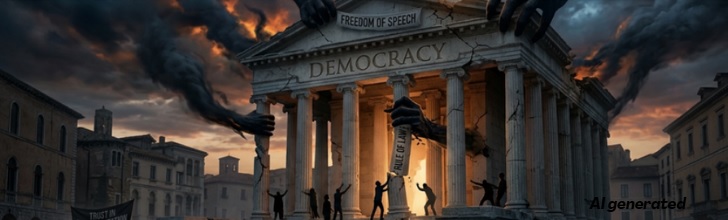
Nowadays, the fact that democracy is at risk is more a reality than an idea. Terms like “democratic break down” or “democratic erosion” are becoming more relevant in recent years. Some countries, such as the USA or the UK, have two totally different concepts of democracy that only share the proper name. We believe that democracy is the participation of citizens in political life and in the global decisions, but sadly this is not a total reality.
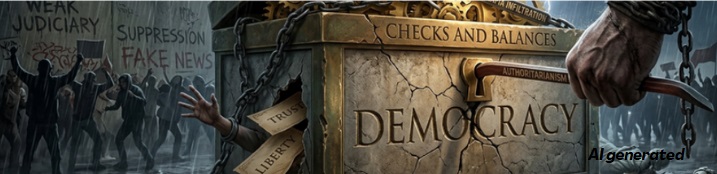
The decline of democracy is not the result of a singular problem, but of many handicaps of this system that could transform it into an autocratic one. Democracy Break Down is materialized into bribery between politics, misinformation and poll tax; while Democratic Erosion is to reduce the scope of judicial review or the expression of liberty. They are connected because if the first one persists, it could be transformed into the Erosion, and the next step in both scenarios is something very similar to an autocracy, or indeed one outright.
Many countries today have democratic systems, but in practice these systems are increasingly moving away from the real meaning of that concept. Curiously, they do so precisely by using the very tools that those same systems provide. In recent months, the government of the US president, Donald Trump, has proposed a measure that apparently aims to put an end to electoral fraud and establish stricter control over voting. Such proposals usually have a fair objective and are accepted by most people. However, in practice this would involve requiring forms of identification such as passports or birth certificates, both of which require the payment of fees in order to be issued. The result would be millions of voters unable to exercise their right simply because they cannot afford to pay the fee. In the end, the cure becomes worse than the disease.
We can find examples of democracy’s decline in a large number of countries and one of them being the UK, in which we can find just a sliver of what is happening all around the world: The Reduction of the freedom of speech with the Online Safety Bill which has been taken as an example by a large number of countries, the Police, Crime and Courts Act in 2022 and the Public Order Act in 2023 that gives more power to the police and government to stop protests, and lastly, the lack of opportunity for participation in the election of the Second Chamber, thus not allowing citizens to take part in it.
There are many other reasons why democratic systems are losing legitimacy among citizens. Numerous studies point to a wide range of causes behind this phenomenon, from the influence of organised crime in the most affected countries to the lack of trust in political representatives due to unfulfilled promises. However, among them, economic inequality stands out. We believe that civic honesty is a fundamental pillar to build a fair system in which citizens can trust.
Another reason is economic inequality. According to the records, when people feel that they cannot make ends meet they think that democracy and the system is not fair because rich and famous people or companies have large benefits and they do not pay taxes and are less controlled by the government. As a result, society begins to lose faith in democracy and this situation unfortunately polarizes all the people and governments have better to manage this situation and find solutions that can help many people.
To sum up, there are many reasons and records that show us why democracy is at risk. Therefore, society and governments need to take some measures, above all politicians would do better to manage this situation by increasing trust and confidence with the population. On the other hand, we cannot allow rights and freedoms to be curtailed because it took many years of democracy and sacrifice by many people to reach the point as we are now. So, do not give up on your rights and fight for them because behind them there are many people who gave their lives.
The second opinion essay was written by Ainhoa Sánchez Alfonso and Alexandra Khmeleva
C1.1 EOI Plasencia
Firstly, we need to bear in mind that key threats include the erosion of trust and the spreading of misinformation. Populist leaders challenge independent institutions and weaken judicial autonomy. In our view, the relationship between the mafia and democracy is deeply paradoxical. Often, democratic freedoms create a favorable environment for criminal structures, while these structures themselves undermine the foundations of the system. We had better not ignore this infiltration. If a leader claims that corruption is under control, but it doesn’t seem so, then the state is in peril.
Nowadays, it is a well-known fact that democratic deterioration is a persistent long-term trend, with more countries moving toward authoritarianism than democracy. The way we see the situation is that democracy is facing a significant global crisis, with many indicators suggesting a decline in political freedom. As authors, we believe that we had better address these structural cracks before they become irreparable. While some view democracy as an immovable pillar, we do not. If we want to save our systems, we must do so immediately.
Seldom do we realize that it is the citizens’ unwavering belief in their institutions that truly prevents a democracy from crumbling; once that faith is lost, the foundations become fragile. This is how the mafia takes part in these processes. By observing how criminal groups seek to become part of the government system through «democratic crimes» like tax evasion, one can identify the start of an erosion. Such actions weaken civic honesty. We had better recognize that a dishonest elite breeds a cynical electorate. Does transparency matter? We think so. If the public loses interest in justice, the mafia will.
For instance, the UK has seen intense debate over democratic health. Critics point to restricted protest rights and challenges to judicial fairness. These internal pressures demonstrate that even well-established systems are not immune to backsliding. Some institutions have managed to resist; others have not. We might wonder: had we better re-evaluate our own domestic policies? If so, we must act now.
In conclusion, democracy is under unprecedented pressure. Its protection requires more than just the act of voting; it demands a commitment to transparency and legal accountability. Many experts suggest that we need more participation, and so do we. Ultimately, the current crisis highlights that we are at a turning point. We had better restore institutional trust, as we want to maintain our liberties.
También te puede interesar
-
Ángeles Espinosa: comprender Oriente Medio más allá de los titulares
-
¿Qué impulsa a unos jóvenes de dieciséis años a representar La casa de Bernarda Alba en el siglo XXI?
-
Democracia: un ideal antiguo, un reto moderno
-
LOS JÓVENES EN LA UNIÓN EUROPEA
-
El peligro de la democracia a través de la mirada de Katniss Everdeen